Information Modelling Framework (IMF) – the logic that makes engineering information computable
Industrial projects depend on vast amounts of technical information exchanged across disciplines and lifecycle phases. Yet much of this information remains locked in documents—PDFs, spreadsheets, and drawings—that are difficult to integrate, compare, and verify automatically. This creates friction, misunderstandings, and costly rework. Through the Tec4MaaSEs project, we are addressing this challenge with a Semantic Framework that enables structured, machine-interpretable information exchange.
The Organization
The University of Oslo (UiO) is Norway’s oldest and highest-ranked university, with internationally recognized research in informatics and semantic technologies. Within Tec4MaaSEs, UiO leads the development of the semantic framework (Task 2.4), contributing expertise in knowledge representation, ontology engineering, and industrial data modelling. Our research group has extensive experience in applying formal methods to real-world engineering challenges, collaborating closely with industry partners including Aibel to ensure practical applicability.
The Challenge
Modern manufacturing ecosystems require seamless information flow between equipment manufacturers, system integrators, and facility operators. Today, critical specifications, requirements, and design decisions are scattered across documents that humans must manually interpret and reconcile. When a flowmeter’s specifications need to be verified against system requirements, an engineer must locate the relevant documents, extract the data, and perform the comparison manually—a process prone to error and delay.
Our Solution: The Information Modelling Framework
At the core of our semantic framework lies the Information Modelling Framework (IMF): an engineer-friendly language to describe and build precise information models of engineering systems. Think of IMF as creating a ‘digital twin’ for your system’s knowledge—capturing what systems are, what they do, how they are connected, and how requirements relate to solutions.
IMF enables you to express:
- Composition: What parts make up a larger system (e.g., ‘Pump-101 partOf the Cooling System’)
- Connections: How components link together (e.g., ‘Pipe-A connectedTo Pump-101’s outlet’)
- Traceability: How designs fulfil requirements (e.g., ‘Pump-101 fulfilledBy Requirement-4.5.2′)
- Location: Where equipment is installed (e.g., ‘Valve-5 locatedIn Zone-B’)
Unlike 3D models or document collections, IMF represents systems as connected information elements—blocks, terminals, connectors, and attributes. IMF is designed to balance simplicity (so engineers can use it), expressivity (so real systems can be described meaningfully), and formal rigor (so models can be validated automatically).
Multiple Viewpoints Through Aspects
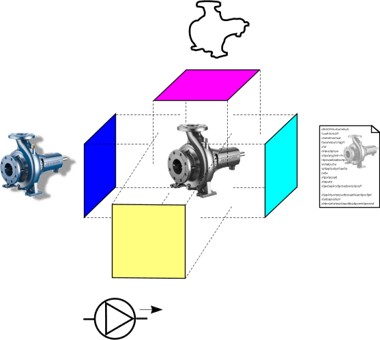
A distinctive feature of IMF is its use of aspects—different viewpoints for describing the same asset. Based on the IEC/ISO 81346 standard, aspects allow a single pump concept to be viewed from the function aspect (as a pumping capability), from the product aspect (as a specification sheet from a manufacturer), from the location aspect (as a physical space in a facility), and from the installed aspect (as a tagged piece of equipment in operation). This multi-perspective approach ensures that different stakeholders can work with the same underlying information while viewing it through their professional lens.
From Visual Models to Knowledge Graphs
Engineers create IMF models using a visual editor where elements are color-coded by aspect for immediate interpretation. These graphical models can then be automatically transformed into knowledge graphs using open W3C standards: RDF (Resource Description Framework) for data structuring, OWL (Web Ontology Language) for semantic relationships, and SHACL (Shapes Constraint Language) for validation rules.
The following figure presents an IMF model of a Tec4MaaSEs pilot use case, created using the IMF editor. It captures the requirement for a magnetic flowmeter and the supplier’s response, representing each as distinct blocks with their various attributes and aspects.
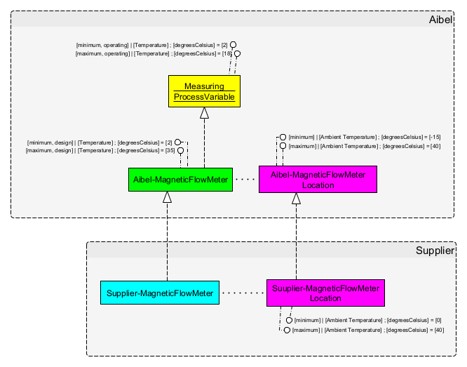
This transformation enables powerful automation. For instance, when a supplier delivers equipment specifications as structured IMF data, the system can automatically verify whether those specifications satisfy the project’s requirements—replacing hours of manual document review with seconds of automated reasoning.
Integration with Industry Standards
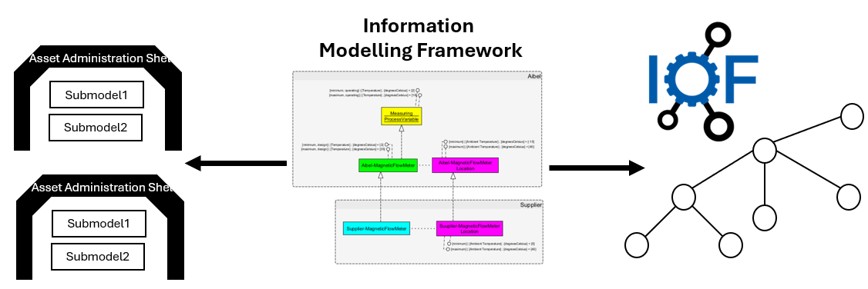
IMF does not exist in isolation. Our semantic models align with the Industrial Ontologies Foundry (IOF), ensuring compatibility with emerging industry standards. Within Tec4MaaSEs, IMF also interfaces with Asset Administration Shells (AAS)—the Industry 4.0 standard for digital twins—and contributes to the project’s Manufacturing-as-a-Service ontology.

Together, these integrations position IMF as a semantic bridge between engineering design, digital twins, and service-oriented manufacturing ecosystems.
Looking Ahead
IMF demonstrates how semantic technologies can move beyond theory into everyday engineering workflows. By combining familiar engineering concepts with formal semantics and open standards, IMF enables clearer communication across disciplines, more reliable information exchange between organizations, automated validation of requirements and solutions, and seamless integration with digital twins and service platforms.
As Tec4MaaSEs continues to evolve, IMF provides a robust foundation for scalable, interoperable, and future-proof digital manufacturing ecosystems—where information is no longer just exchanged but understood.
For more information about IMF, visit imfid.org.