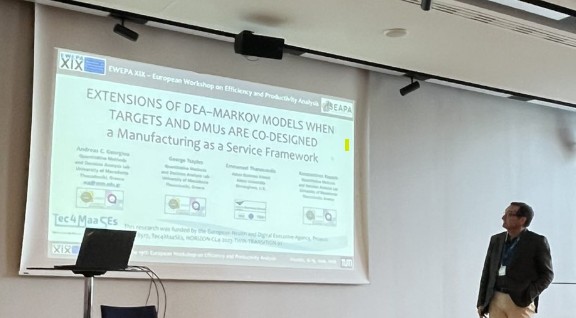
In the course of the 19th European Workshop on Efficiency and Productivity Analysis (EWEPA – XIX), Professor Andreas C. Georgiou of University of Macedonia presented a novel research relevant to Tec4MaaSEs.
The presentation was entitled “Extensions of DEA-Markov models when targets and DMUs are co-designed: a Manufacturing as a Service Framework”.
Abstract. This paper advances the DEA–Markov framework by introducing complementary extensions that enhance its capacity to support dynamic decision-making in evolving systems. First, the Dual-Frontier model treats both recruitment policies and target structures as synchronized, co-designed elements. Aspirational targets form their own convex frontier, allowing the model to identify efficient policy–target pairs that jointly satisfy Markov balance relations. This enables managers to distinguish between attainable and desirable evolution paths and to analyse how different target configurations interact with feasible interventions. Second, the Open-Time Control model adopts the time horizon as a decision variable. Therefore, instead of assuming a fixed number of transitions, the model determines the optimal duration required to reach a target structure under Markovian dynamics. By combining DEA-based efficiency measures with stepwise system evolution, the framework evaluates the trade-off between transition speed, policy effort and target attainment. Both extensions preserve linearity and interpretability while transforming DEA–Markov models from static evaluators into dynamic design instruments capable of generating efficient trajectories in multi-period environments