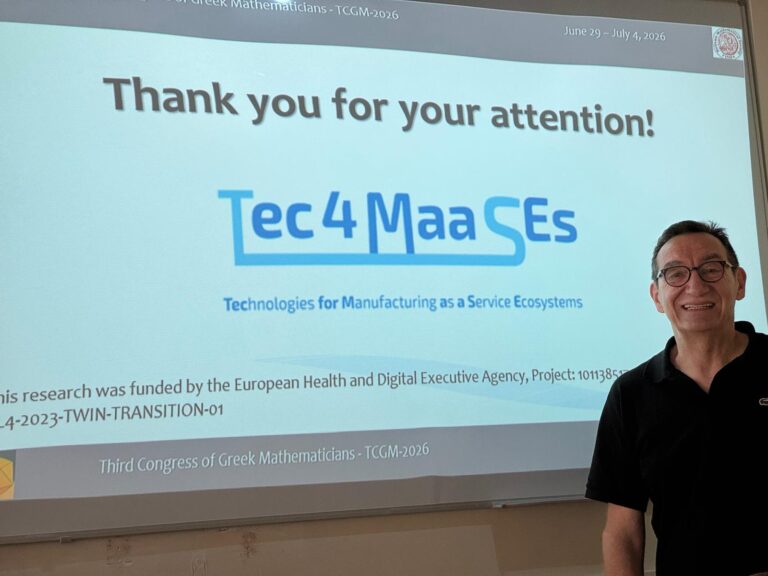
In the course of the Third Congress of Greek Mathematicians (TCGM-2026), held in Athens, Greece on June 29- July 4 2026, Professor Andreas C. Georgiou presented the Tec4MaaSEs work entitled “RECENT EXTENSIONS AND DEVELOPMENTS IN DEA-MARKOVIAN MODELS – MODELS FOR TRANSITION AND CYCLICICY”
Abstract: The emergence of Manufacturing as a Service (MaaS) ecosystems introduces new challenges for decision-making in dynamic environments where resources, service providers, products, and demand patterns evolve over time. Understanding and guiding such evolution requires analytical frameworks capable of combining performance assessment with stochastic system dynamics. This paper presents recent extensions and developments of DEA–Markovian models that enhance their ability to support strategic decision-making in evolving socio-technical systems characterized by transition and cyclicity. The proposed framework introduces a Dual-Frontier formulation in which intervention policies and aspirational targets are simultaneously modelled and co-designed. In addition to the conventional efficiency frontier, target structures form their own convex frontier, enabling the identification of efficient policy–target combinations that satisfy Markovian balance relations while reflecting long-term strategic objectives. This allows decision makers to distinguish between attainable and desirable development pathways and to evaluate trade-offs between intervention effort, transition speed, and target attainment. The methodology is particularly relevant for MaaS environments, where service composition, provider networks, resource allocation, remanufacturing activities, and ecosystem evolution must be coordinated under uncertainty. By integrating efficiency analysis with stochastic transition dynamics, the proposed DEA–Markovian framework supports the evaluation of alternative intervention strategies and their impact on system evolution over time. Furthermore, the framework accommodates cyclic processes that are increasingly important in circular economy settings, where products, materials, and resources repeatedly move across multiple states and value-creation stages. The resulting models provide a versatile decision-support tool for analysing transitions and cyclical behaviours in complex systems, with potential applications ranging from Manufacturing as a Service ecosystems and circular value networks to workforce planning, healthcare systems, and the transition towards electrification. The framework contributes to the growing literature on dynamic efficiency analysis and supports the broader twin-transition agenda linking digitalisation, sustainability, and system transformation.